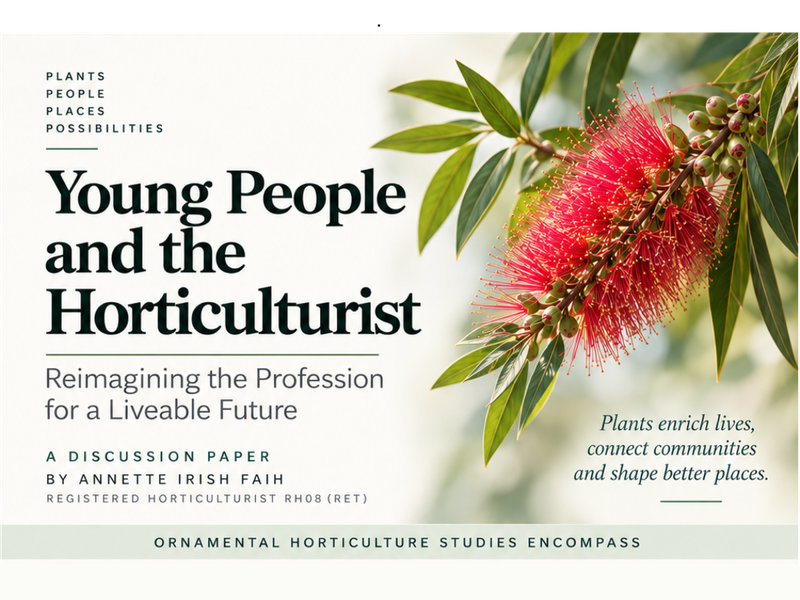
Horticulture is frequently presented to young people as a narrow collection of gardening or manual occupations, yet the profession now operates at the intersection of plant and soil science, urban greening, food systems, biodiversity, climate adaptation, water management, biosecurity, technology and human wellbeing.
This paper examines whether contemporary education and career pathways are capable of attracting and supporting young people, and whether professional horticultural skills remain necessary to healthy societies and communities. It draws together Australian Institute of Horticulture research, the Occupation Standard Classification for Australia (OSCA) advocacy work, Australian vocational and higher education pathways, and international skills frameworks, particularly Singapore’s structured landscape-sector model.
The evidence supports a clear conclusion: horticultural skills are not becoming obsolete. Rather, their application is becoming broader and more technically demanding. The central challenge is visibility. Young people require accessible pathways from first contact with plants through vocational education, higher education, employment, professional recognition, mentoring and leadership. At the same time, society requires practitioners who can make sound decisions about plants, soils, water and living landscapes over long timeframes.
Horticulture should therefore be presented not simply as an occupation concerned with gardens, but as a profession responsible for the health, function and stewardship of living systems in both built and natural environments.
Leave a Reply
You must be logged in to post a comment.