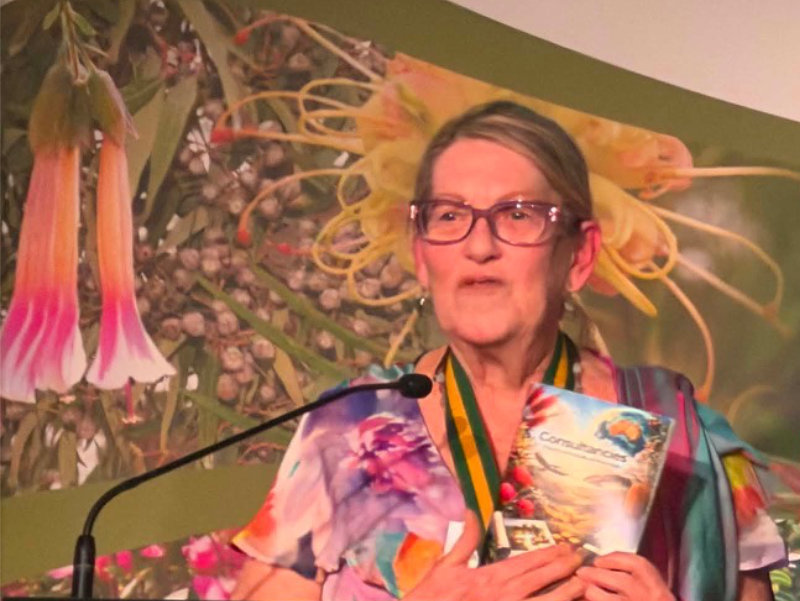
I was rather delighted to receive the Australian Institute of Horticulture Award of Merit for my booklet Consultancies – Fees for Horticultural Practices at the 2026 AIH Awards Dinner in Adelaide.
It may be a small booklet, but there are quite a few years tucked inside its pages!
Much of what I have written comes from decades of running my own consultancy and working with horticulturists, landscape professionals, businesses, government agencies, educators and industry organisations in Australia and overseas.
One thing I learnt very early is that being a good horticulturist does not automatically teach you how to run a good consultancy.
Besides all the accompanying regulations and business management tasks living in the snake pit:
- How do you decide what your professional knowledge is worth?
- What should you charge?
- What is actually included in a consultancy fee?
- When does a conversation become professional advice?
- And, perhaps most importantly, how do we stop undervaluing the knowledge and experience that horticulturists bring to a project?
But good consultancy practice involves much more than setting a fee.
Well-managed data, accurate record keeping and timely communication are essential. Keeping proper notes of meetings, decisions, advice and changes to a project may seem rather mundane when compared with selecting plants or solving an interesting horticultural problem, but good records protect both the consultant and the client. Being timely with reports, correspondence, accounts and follow-up is equally part of being a professional.
Then there is that other essential consultancy skill — patience.
Clients quite rightly have strong ideas about what they want. Sometimes those ideas are horticulturally inspired and sometimes, shall we say, they require a little further discussion.
A consultant may find themselves explaining why a much-loved plant simply will not flourish in the position chosen for it, or why a design that looks marvellous on paper may be considerably less marvellous once plants, soils, climate, maintenance and the realities of the site become involved.
There can also be occasions when the consultant needs to resist being drawn into differences between partners about what the garden should look like. I have a fairly well-known expression for these occasions: “Get the domestics out of the way first!”
It is said with a smile, but there is a serious point behind it. A consultant is there to provide professional horticultural advice, not to adjudicate on whether one partner’s beloved collection of plants takes precedence over the other’s vision for the garden.
Likewise, commercial developments can bring very rigid requirements that do not always sit comfortably with good horticultural practice — and sometimes a design that someone is absolutely convinced will look marvellous simply won’t work on the site.
In both situations, patience, diplomacy and sound professional advice are generally more useful than becoming part of the argument.
Sometimes our job is to say, very politely, “I understand what you would like to achieve; now let us look at what will actually work.”
These are not always comfortable conversations, but they are part of professional consultancy. Our responsibility is not simply to give clients what they ask for, but to use our knowledge and experience to help them achieve the best practical and sustainable outcome for their site.
This little booklet grew from my desire to pass on some of the practical things I have learnt — sometimes successfully and, on occasion, by learning what not to do!
Receiving the Award of Merit for this work was therefore particularly special.
My thanks to the Australian Institute of Horticulture for the recognition, and to the many colleagues, clients and fellow horticulturists who have contributed to my knowledge over the years.
Horticulture is a profession built on sharing knowledge. If this little publication helps another horticulturist value their expertise, maintain good professional practice and run a stronger consultancy, then it has done its job.
Leave a Reply
You must be logged in to post a comment.